

Call for contributions to NHNAI 2nd International conference
AI for Human Flourishing – On Human Terms
Fostering Collective Discernment to safeguard Dignity, Responsibility and the Common Good in the Age of AI
Budapest, 21–23 April 2027
2nd Conference of NHNAI network co-organized by Lyon Catholic University (UCLy) and Pázmány Péter Catholic University*
Scope and rationale:
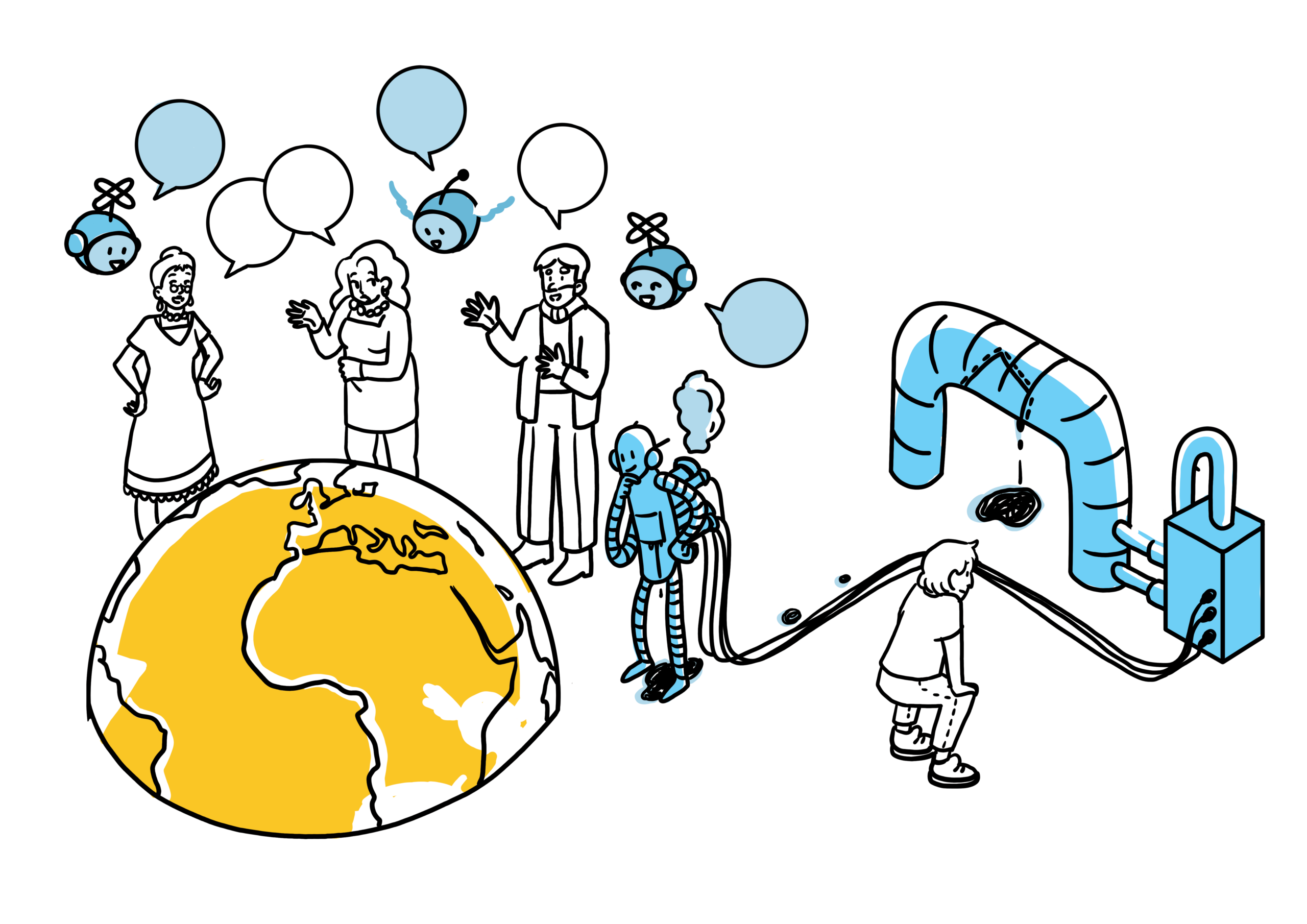
This conference begins with a simple but demanding question: under what conditions can artificial intelligence contribute to genuine human flourishing? The question is not merely whether AI can be useful, efficient or innovative. It is also, and maybe most importantly, how the technological systems now entering education, work, communication, public administration, health care, law and culture can preserve and contribute to the dignity of persons, the responsibility of communities and the common good. We must reflect upon our personal and collective responsibility, and identify what concrete paths can help develop and use AI at the genuine service of human flourishing. Although there is no doubt AI is one of the most remarkable achievements of human intelligence, the path we are currently on is far from guaranteeing that it will become a human achievement in full sense.
The current era of AI—driven by advances like deep learning and Large Language Models (LLMs)—is marked by frenetic development and intense global competition. This rush is fueled by the perception of AI as a primary economic driver and a source of power, leading to a “tyranny of tardiness”[1] where attempts at regulation are protested as economic and geostrategic suicide. This hectic, competition and market-driven environment, coupled with growing power asymmetries favoring tech giants who often adhere to techno-solutionist ideologies,[2] makes ethical AI development extremely challenging at a time when it is needed more than ever.[3] As Hans Jonas long put it, such uncritical relationship to technology may allow for technological development to “continuously [gather] new momentum, carrying its carriers along as its appointed instruments.”[4] To move beyond this uncritical embrace of technology and put AI genuinely at the service of humanity, top-down regulations and corporate social responsibility frameworks are necessary but not sufficient. Collective and intense efforts of ethical capacity-building must also be conducted to empower the individual and collective discernment and contribute to a strong horizontal and bottom-up support to the democratic governance of AI. More than a mere challenge of regulation, what our societies are confronted with is the urge to commit to a “long overdue work of reinvention.”[5] Simply pointing out power imbalances isn’t enough. They must be confronted. Nevertheless, adequately orientating the development and use of AI is the responsibility of all concerned persons. In fact, power asymmetries are not the sole obstacle on the road of robust AI ethics and democratic governance. Another challenge is to be able to set goals and purposes to AI. This is a decisive collective responsibility.[6] What are the society projects AI should serve? What are the visions of human nature, development and flourishing that will operate in the background? Academics and experts, universities and other research and education institutions must contribute to this collective effort of ethical-capacity building, especially through exploration of what it means to be human in the age of AI.[7] The conference intends to open an interdisciplinary and transdisciplinary dialogue on the various forms these contributions could take and the contents they should bring.Core questions along two main thematic axes
The guiding question of the conference is: What must we do to foster human collective ethical capacity-building so that AI remains under human responsibility and contributes to a genuine human future? The spirit of the conference is therefore both theoretical-reflective and action-oriented. We want to create a space for articulation and mutual enrichment of both academic and theoretical inquiry on the one hand, and practical and contextualized discernment efforts on the other hand. The discussions will thus follow two main thematic axes:
The guiding question of the conference is: What must we do to foster human collective ethical capacity-building so that AI remains under human responsibility and contributes to a genuine human future? The spirit of the conference is therefore both theoretical-reflective and action-oriented. We want to create a space for articulation and mutual enrichment of both academic and theoretical inquiry on the one hand, and practical and contextualized discernment efforts on the other hand. The discussions will thus follow two main thematic axes:
1. Shared exploration and understanding of what it means to be human in the age of AI
This first axis bears upon the content and conceptual milestones that can best support ethical capacity-building and collective discernment efforts. The goal is to identify the most crucial insights that we should mobilize to reflect upon what it does mean to be human in the age of AI. We will thus keep room for foundational questions—free will, responsibility, the difference between humans and machines (what does AI reveal or obscure about the human person?), and the ethical and anthropological frameworks needed to think clearly about AI.
But the intention is not to define the human once and for all, to bring the answer to the question of what it means (or should mean) to be human. Rather, the conference aims to build a common ground gathering as many perspectives as possible (from various academic / theoretical disciplines, but also with feedback from learning after discernment and ethical orientation efforts in concrete contextualized settings). The goal is to contribute to a rich, plural, and rigorous picture of the human that makes room to the complexity of the issue and that can, in turn, be shared as a common resource for contextualized discernment and ethical orientation purposes in the age of AI.
2. From shared understanding to concrete orientation and practice
The conference also intends to emphasize what it takes to act well with respect to AI. How should we organize ourselves to allow for fruitful mobilization of the common reflection upon what it means to be human?
Many different questions must be addressed:
-
-
How can (catholic) universities, public authorities, the Church and other religious authorities, professional communities and civil society ensure altogether robust processes of ethical capacity-building for designing, regulating and using AI responsibly in concrete settings?
- What expertise is needed to empower collective reflection (in institutions, education, organizations, and public life)?
-
What methods and experiences can guide us to make the reflective / theoretical dimension actionable in concrete discernment settings and to permit contextualized experience of ethical discernment to feed the background reflection (e.g., value-sensitive design, transdisciplinary collaborations, organizational models)?
-
What examples already exist of meaningful and successful connections of this type? Implementation in local discernment initiatives of a shared background reflection about what the human means? Effective creation of added value with AI in such a way? Examples of feedback?
-
We invite not only academic researchers, but also practitioners involved in discernment efforts with respect to AI technology or stakeholders’ representatives to submit proposals for contributions along those two axes (under the form of usual presentations and roundtables, but also through more open discussion panels). All disciplinary perspectives are welcome (human and social sciences, philosophy or ethics of theology as well as natural and computer sciences or healthcare and medicine fields. Again, practitioners or stakeholders’ representatives are also warmly invited to submit a contribution.
Conference form and expected outcomes:
Beyond academic production: responsibility and discernment
The conference is rooted in the conviction that academic work cannot stop at producing books and articles. In a context where AI increasingly shapes humans and societies, researchers and institutions have a stronger responsibility: to play their part within communities they belong to, to think, decide, and act wisely with respect to AI development and use.
This is why the conference aims to be more than a standard scholarly event. It seeks to contribute to an effort of collective discernment:
-
Helping to clarify what is at stake, to identify what should be preserved and promoted.
-
But also exploring how to gain traction, how for fundamental reflection to have an impact rather than be only performative, what practical ways to orient AI development and usage toward a truly bright human future.
AI is not to be treated as an autonomous horizon before which the human person must adapt without question. Nor is it to be feared as if technology were necessarily hostile to humanity. It is to be judged, shaped and governed according to human dignity, truth, freedom, justice, peace and the common good.
Conference form
The conference will unfold through several keynote speeches and panels of presentations as usual in academic settings. However, we will also organize panels devoted to exchanges and discussions in more open settings, especially to favor the exchanges between researchers and practitioners or stakeholders.
Expected outcomes
First and foremost, the conference will provide the opportunity to reinforce and expand the NHNAI network, which gathers academics, practitioners and stakeholders sharing the endeavor of fostering ethical capacity-building and collective discernment efforts, especially through exploration of what it means to be human. The event will allow to cultivate and grow the bounds and shared resources NHNAI network members can rely on to contribute to this endeavor at local and global levels.
A collective publication of the conference papers will be proposed.
A statement or a concise set of principles for Catholic universities and partner institutions will also be considered.
Conference venue and program
The conference will be hosted in Budapest (Hungary) by the Pázmány Péter Catholic University.
The conference will be held mainly face-to-face. However, a live stream will be provided for all major events.
Preliminary program:
- Wednesday 21st of April 2027
- 6 – 7:30 pm: Opening ceremony
- 7:30 – 10 pm: Cocktail
- Thursday 22nd of April 2027
- 9 am – 6:30 pm: Plenary and parallel sessions
- 7:30 pm: Conference dinner
- Friday 23rd of April 2027
- 9 am – 1 pm: plenary and parallel sessions
- 1 pm: Closing ceremony and Cocktail
Modalities of contribution submission:
Submission of abstracts (500-1000 words) for presentations or panels of discussions addressing the main issues raised by the conference is welcome by email (nhnai-network@univ-catholyon.fr). The presentation of panel proposals on specific topics in the indicated lines of research is also possible. The deadline for submitting proposals is November 30, 2026.
Scientific and organization committees:
Organization committee:
- Krisztián Vincze (Pázmány Péter Catholic University)
- András Nagy (Pázmány Péter Catholic University)
- Franck Violet (Lyon Catholic University)
- Laura Di Rollo (Lyon Catholic University)
- Mathieu Guillermin (Lyon Catholic University)
Scientific committee:
- Taylor Black (The Catholic University of America)
- Krisztián Vincze (Pázmány Péter Catholic University)
- András Nagy (Pázmány Péter Catholic University)
- Mario De Caro (Università di Roma Tre/Tufts University)
- Franck Violet (Lyon Catholic University)
- Thor Wasbotten (Belmont University)
- John Selvamani (Fu Jen Catholic University)
- Juan Larraín Correa (Pontifical Catholic University of Chile)
- Alejandra Marinovic Guijón (Pontifical Catholic University of Chile)
- Nathanaël Laurent (University of Namur)
- Montserrat Alom (International Federation of Catholic Universities)
- David Doat (University of Namur – UNESSA)
- Samuel A. Nyanchoga (The Catholic University of Eastern Africa)
- Mathieu Guillermin (Lyon Catholic University)
* Joint conference within the framework of the project “New Humanism in the time of Neuroscience and Artificial Intelligence” (NHNAI, coordinated by UCLy under the aegis of the International Federation of Catholic Universities) and the project “On the Border Between Humans and Machines” (coordinated by the Pázmány Péter Catholic University and the Catholic University of America). [1] Dominique Boullier, ‘Sommet IA : la nécessaire sécession sémantique européenne – AOC media’, AOC media – Analyse Opinion Critique, 9 February 2025 <https://aoc.media/analyse/2025/02/09/sommet-ia-la-necessaire-secession-semantique-europeenne/> [accessed 21 October 2025]. [2] Shoshana Zuboff, The Age of Surveillance Capitalism: The Fight for a Human Future at the New Frontier of Power (PublicAffairs, 2020); Rob Lalka, The Venture Alchemists: How Big Tech Turned Profits into Power (Columbia University Press, 2024); Marietje Schaake, The Tech Coup: How to Save Democracy from Silicon Valley (Princeton university press, 2024). Marc Andreessen, ‘The Techno-Optimist Manifesto’, Andreessen Horowitz, 16 October 2023 <https://a16z.com/the-techno-optimist-manifesto/> [accessed 24 June 2025]. [3] A recent open letter, which received the support of many public personalities and famous researchers, expresses deep concerns associated with the possible emergence of super AI, ‘ranging from human economic obsolescence and disempowerment, losses of freedom, civil liberties, dignity, and control, to national security risks and even potential human extinction,’ see: ‘Statement on Superintelligence’, Statement on Superintelligence, 2025 <https://superintelligence-statement.org> [accessed 26 October 2025]. For a less mediatic but more thorough analysis, see: Bengio, International AI Safety Report, sec. 2.2.3. [4] Hans Jonas, Philosophical Essays: From Ancient Creed to Technological Man (Prentice-Hall, 1974), p. 48. [5] Shoshana Zuboff, ‘Democracy Can Still End Big Tech’s Dominance Over Our Lives’, TIME, 5 May 2022 <https://time.com/6173639/democracy-big-techs-dominance-shoshana-zuboff/> [accessed 25 October 2025]. [6] This shared responsibility is vibrantly put forward in Leo XIV recent encyclical Magnifica Humanitas (15 May 2026): “No one can single-handedly bear the weight of the challenges the world is facing, just as no one is so weak that they cannot play their part” (13). “The civilization of love will not arise from a single or spectacular gesture, but from the sum total of small and steadfast acts of fidelity that serve as a bulwark against dehumanization.” (213) “Let us invest in education, beginning with ourselves! (…) Teaching new generations that technological evolution does not follow a predetermined path, but can be guided by personal and collective responsibility, constitutes one of the most valuable services to the common good.” (238). See: https://www.vatican.va/content/leo-xiv/en/encyclicals/documents/20260515-magnifica-humanitas.html [7] Mathieu Guillermin, “New Humanism in the Time of Neuroscience and Artificial Intelligence: An International Action Research Project,” in The Future Of Hope, ed. Renata Salvarani (Edizioni Studium, 2025), https://doi.org/10.69080/TheFutureOfHope.83-95.