
Being human in the time of neuroscience and artificial intelligence involve carefully exploring the nexuses of complexity where valid ideas are nevertheless in tension, manifesting subtleties and challenges that must not be overlooked. Each page expresses the existing tension(s) between ideas and within each theme, which emerged in the collective discussions, and are then complemented by insights from NHNAI network researchers.
Transversal complexity #5: AI and ecology
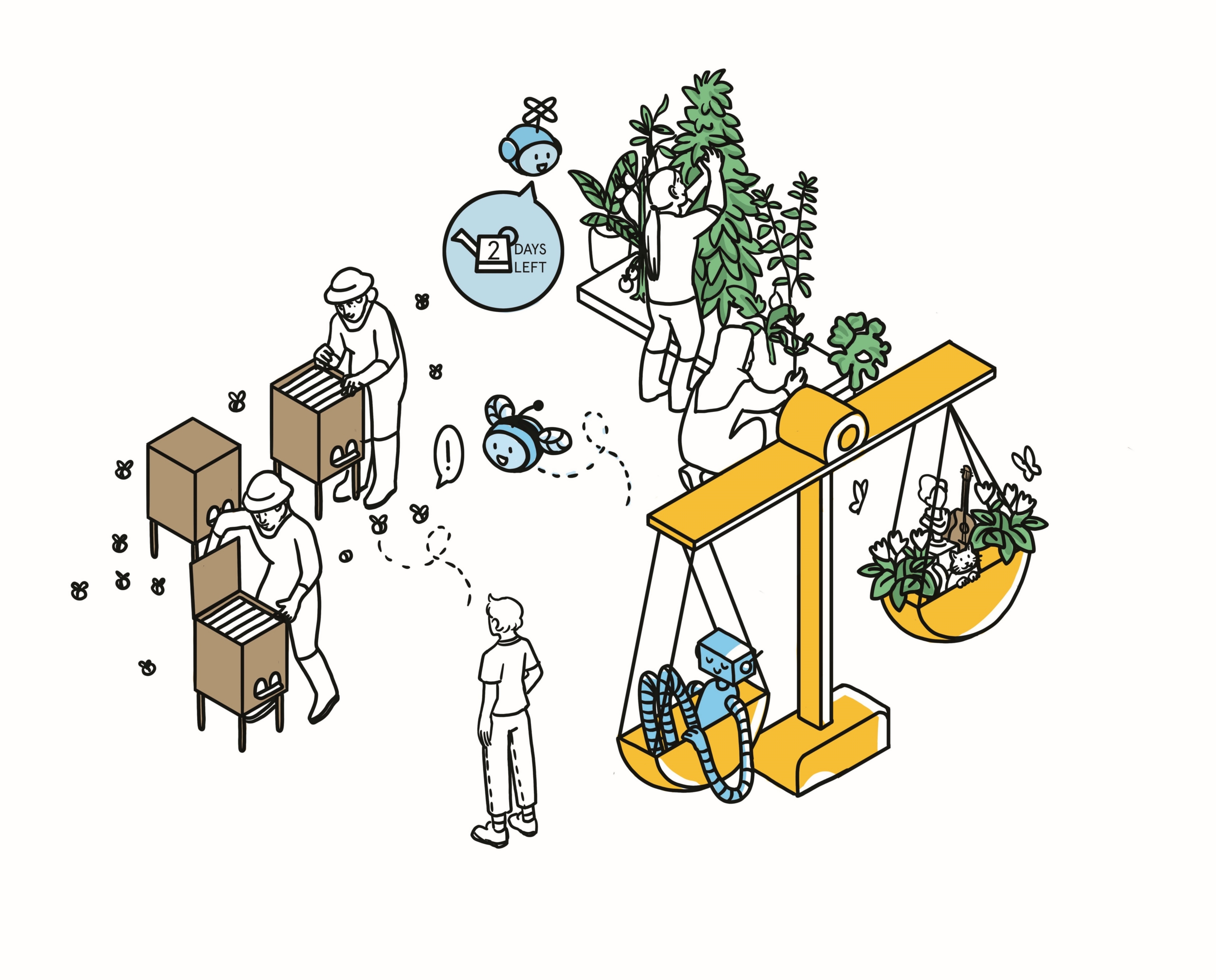
NHNAI discussions manifest a deep point of tension concerning the relationships between AI and ecological transition or environmental questions.
On one hand, AI technologies can be used to adapt and combat global warming. For instance, AI is efficient to forecast future climate disasters, thus ensuring the security of inhabitants. In addition, AI can reduce pollution and greenhouse gas emissions, and monitor the health of ecosystems. It can also help fighting against illegal and dangerous activities undermining the preservation of environment and biodiversity.
However, on the other hand, AI technologies may induce an important impact on the environment and biodiversity. The rapid and excessive development of AI technologies do not seem compatible with the ecological transition as it uses a lot of resources (metals, water, energy…) and increases global warming by augmenting the greenhouse gas emissions. This is particularly the case for generative AI.
Given the considerable impact of technology on the environment because of its whole life cycle, should we use AI to preserve biodiversity and the environment? Is “AI for green” possible?
Insights from NHNAI academic network:
The contribution of AI to climate mitigation: the case of Kenya
Artificial Intelligence (AI) plays a significant role in climate change mitigation in Kenya and Africa at large, by enhancing data-driven decision-making, promoting sustainable resource use, and improving early warning and response systems. To begin with, one of its most impactful contributions lies in climate data analysis and forecasting. AI models can process large datasets, including satellite imagery and weather records, to predict extreme weather events such as droughts, floods, and heatwaves. As a result, this capability allows governments, farmers, and communities to anticipate and prepare for climate-related challenges, ultimately reducing their vulnerability. In the area of agriculture and food security, AI supports the development of climate-resilient practices. It recommends drought-resistant and fast-maturing crops, optimizes planting schedules, and guides irrigation needs using predictive modeling. Through the use of smart farming technologies that combine remote sensing and machine learning, AI improves crop yields while minimizing environmental impact. Furthermore, in the energy sector, AI enhances energy efficiency by predicting demand and improving the integration of renewable energy sources such as solar and wind into national grids. It also supports the deployment of microgrids and smart energy systems in rural areas, thus contributing to a cleaner and more sustainable energy future.
In addition, AI contributes to natural resource management by tracking deforestation, monitoring land degradation, and managing water resources in real time. This, in turn, enables better conservation efforts, such as reforestation and ecosystem restoration, and helps monitor biodiversity and wildlife migration patterns affected by climate change. Likewise, in urban planning, AI supports the development of climate-resilient infrastructure by modeling climate risks and optimizing transport and construction systems to reduce emissions and environmental impact. Another critical area of impact is disaster preparedness and early warning systems. AI technologies enhance the ability to detect and respond to natural disasters by simulating scenarios, identifying high-risk zones, and guiding emergency response plans.
Moreover, AI supports climate finance and policy by helping governments track carbon emissions, design carbon credit systems, and create data-informed environmental policies. Notably, AI is also transforming agriculture through precision farming, which helps farmers make informed decisions using real-time data collected from sensors, drones, and mobile technologies. This includes monitoring soil moisture, temperature, and other environmental conditions to optimize the use of water, fertilizers, and pesticides thereby increasing productivity while reducing environmental harm. For instance, in Ghana, AI is used to analyze satellite imagery and weather patterns to predict crop yields and manage resources more efficiently, enabling the government to formulate informed agricultural policies that support both productivity and sustainability.
In conclusion, AI is a powerful enabler of climate change mitigation across Africa. Its effectiveness is greatest when integrated with local knowledge systems, mobile technology, and community participation. When responsibly applied, AI offers transformative potential for building a more resilient and sustainable African continent in the face of climate change