
Being human in the time of neuroscience and artificial intelligence involve carefully exploring the nexuses of complexity where valid ideas are nevertheless in tension, manifesting subtleties and challenges that must not be overlooked. Each page expresses the existing tension(s) between ideas and within each theme, which emerged in the collective discussions, and are then complemented by insights from NHNAI network researchers.
Complexity on Health #7: Using AI to prevent social isolation while preserving human interactions
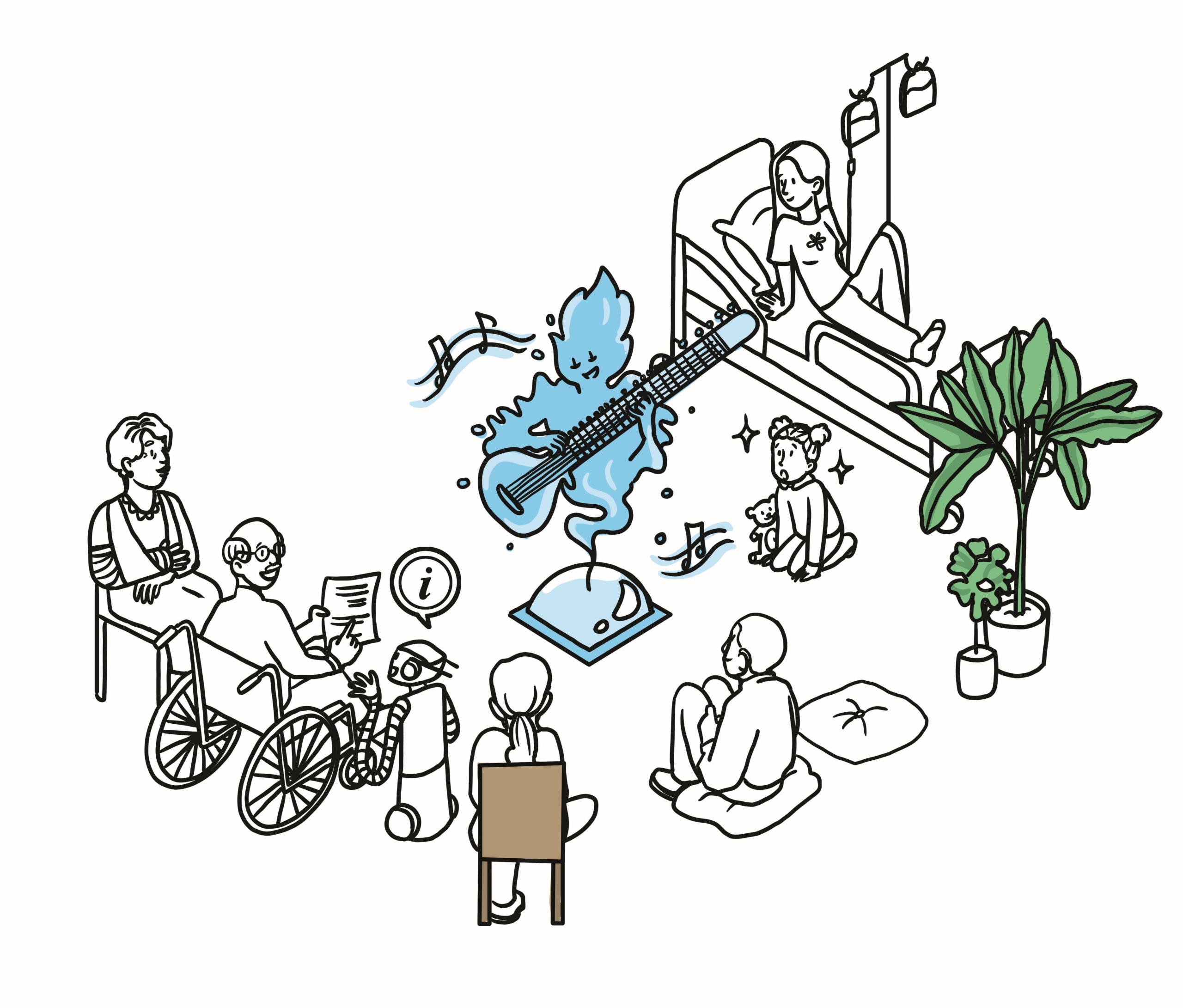
Participants to the NHNAI discussions acknowledge that some AI tools (such as robot companions, chatbots…) can alleviate and prevent social isolation as it can interact with people by imitating the human interaction. Those tools can bring a feeling of contact and affection to people who are lonely. Moreover, artificial companions can be really helpful for healthcare professionals who don’t have the time to talk with every patient, or places where there are not enough healthcare professionals. Finally, robots are used as mediators to help better communicate with others, as is the case for autistic children.
However, participants raise the importance of preserving human interactions which seem to be at the core of healthcare. Participants highlight that human contact cannot be replaced by any AI tool. On top of that, participants emphasize the risk of developing overdependence on those tools, which can lead to trigger or increase social isolation.
Insights from NHNAI academic network:
The issue analyzed within this complex framework is today absolutely central, as in contemporary society it is somewhat more difficult than in the past to form lasting relationships. Many people, especially younger individuals, feel a sense of disorientation in the face of these changes that are reshaping the way we socialize.
Of the two opposing ideas considered by the participants in the debate—on the one hand, that AI could help overcome feelings of isolation, and on the other, that these feelings risk being intensified by excessive use of new technologies—psychological studies conducted so far tend to support the latter: the view that it is impossible to obtain the same emotional benefits from an interaction with a machine as from a human relationship (Pacilli, Giovannelli & Spaccatini, 2021).[1]
This does not mean, however, that there are no specific cases in which it may be worthwhile to rely on machines rather than on other human beings—for example, in the case of individuals who are blind or deaf, who could become more independent through the use of highly advanced technological devices and thus feel freer.
Nevertheless, even in the case of people with disabilities, the valuable contribution provided by machines does not replace a human relationship, but rather a form of practical assistance that would otherwise require the person to depend on others. In moments when a blind or deaf person wishes to confide in someone, it is only natural that they turn to a loved one rather than to a computer.
[1] M. Pacilli, I. Giovannelli & F. Spaccatini, Psicologia sociale dei media digitali, Maggioli, 2021.