
Being human in the time of neuroscience and artificial intelligence involve carefully exploring the nexuses of complexity where valid ideas are nevertheless in tension, manifesting subtleties and challenges that must not be overlooked. Each page expresses the existing tension(s) between ideas and within each theme, which emerged in the collective discussions, and are then complemented by insights from NHNAI network researchers.
Complexity on Education #4: Does AI impoverish and reinforce creative abilities?
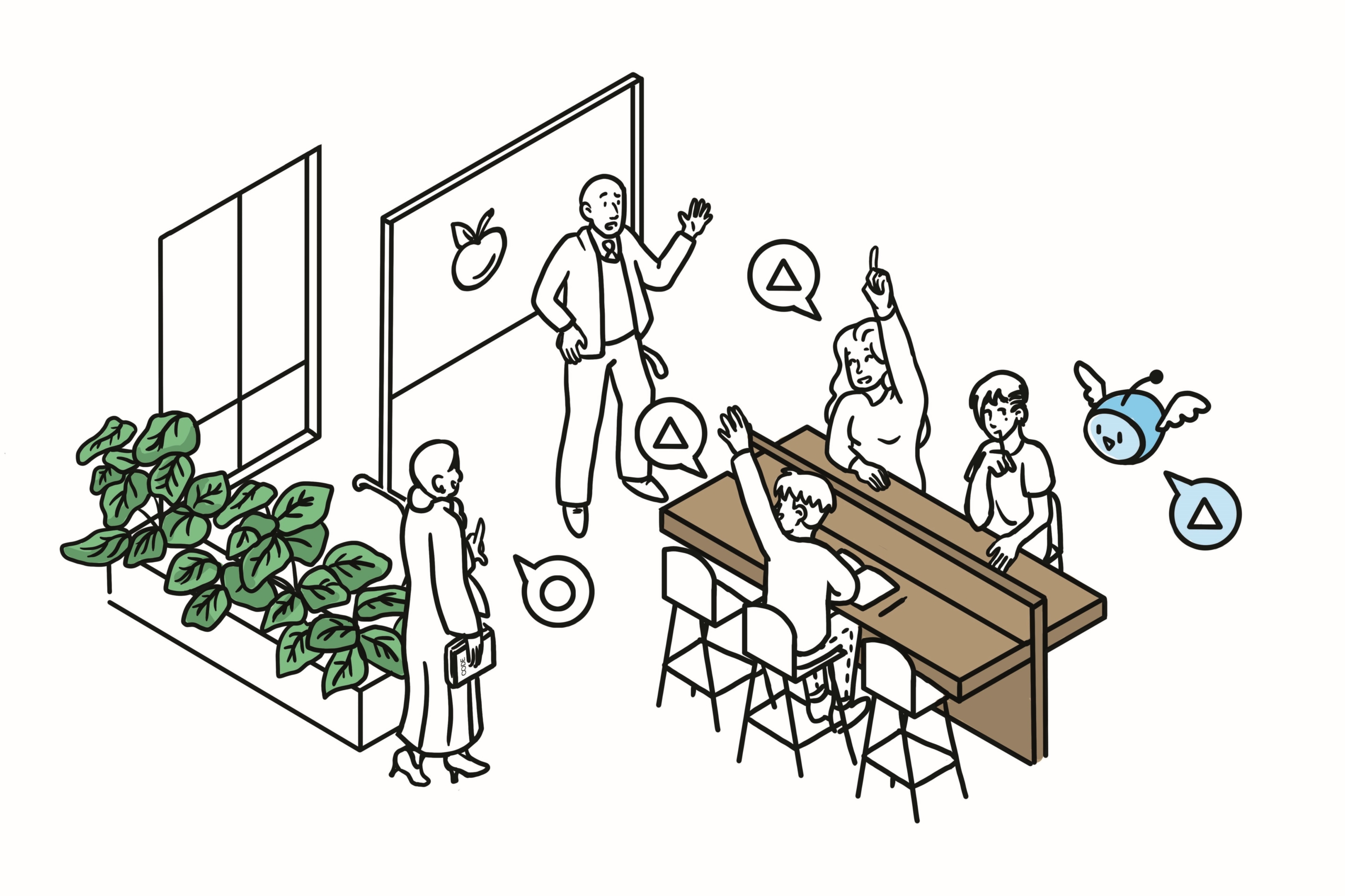
Participants highlight the importance of preserving creativity, an ability largely perceived as unique to humans, sometimes emerging from relationships or practice. Excessive use of AI in education may threaten this ability, for instance with the use of ChatGPT to obtain ready-made answers and homeworks. Overreliance and overdependency on AI could compromise childrens’ critical thinking and creative abilities, notably by reinforcing laziness and procrastination. Moreover, AI might also contribute to impoverish creativity by easily generating products that are similar to those of human artists, reducing the willingness of artists and students to commit to creative jobs or studies.
However, some participants also highlight that AI and notably GenAI can be useful to stimulate creativity, find inspiration and news ideas, etc. Even finding the right prompts to write can be considered as a creative task.
Insights from NHNAI academic network:
Based on insights from Juan R Vidal (associate professor in cognitive neuroscience, Research center Confluences: Sciences and Humanities (EA 1598), UCLy), Federico Giorgi (post-doctoral researcher in philosophy, Université de Namur, ESPHIN) and Nathanaël Laurent (associate professor in philosophy of biology, Université de Namur, Belgium)
A. The frequency of use
The question of the relationship between AI and creativity cannot receive a binary answer. Rather than a yes OR no, we may better think in terms of yes AND no … depending on the context. For example, intensive use of AI may impoverish cognitive and creative capacities of humans, but in small doses it may be used to positively stimulate and to suggest new alleys for thought. The effects and consequences are thus dependent on the frequency of use.
B. Questioning the purpose of education
The current widespread trend of using AI software to complete tasks related to one’s education more quickly and efficiently seems to trigger not only the risk of developing a dependency on such technologies but also, perhaps, a crisis within the educational system as a whole. Students who choose to delegate to machines the tasks assigned to them by teachers or professors appear to have no ambition beyond simply obtaining a diploma. Yet the true purpose of education should be to guide students through a learning process that is, above all, a path of self-development. Such progress, however, can only be achieved through effort, hard work, trial, and error. The excessive use of ChatGPT by many students thus appears strongly connected to the general devaluation of the role of teachers and professors in schools and universities in many countries. Human creativity—though at times seemingly mimicked by technology—is, in the case of students, closely tied to the development of their abilities in a specific field. But the task of guiding students in the discovery of their talents belongs to schools and universities, not to algorithms.