
Being human in the time of neuroscience and artificial intelligence involve carefully exploring the nexuses of complexity where valid ideas are nevertheless in tension, manifesting subtleties and challenges that must not be overlooked. Each page expresses the existing tension(s) between ideas and within each theme, which emerged in the collective discussions, and are then complemented by insights from NHNAI network researchers.
Complexity on Education #5: What is the purpose of education?
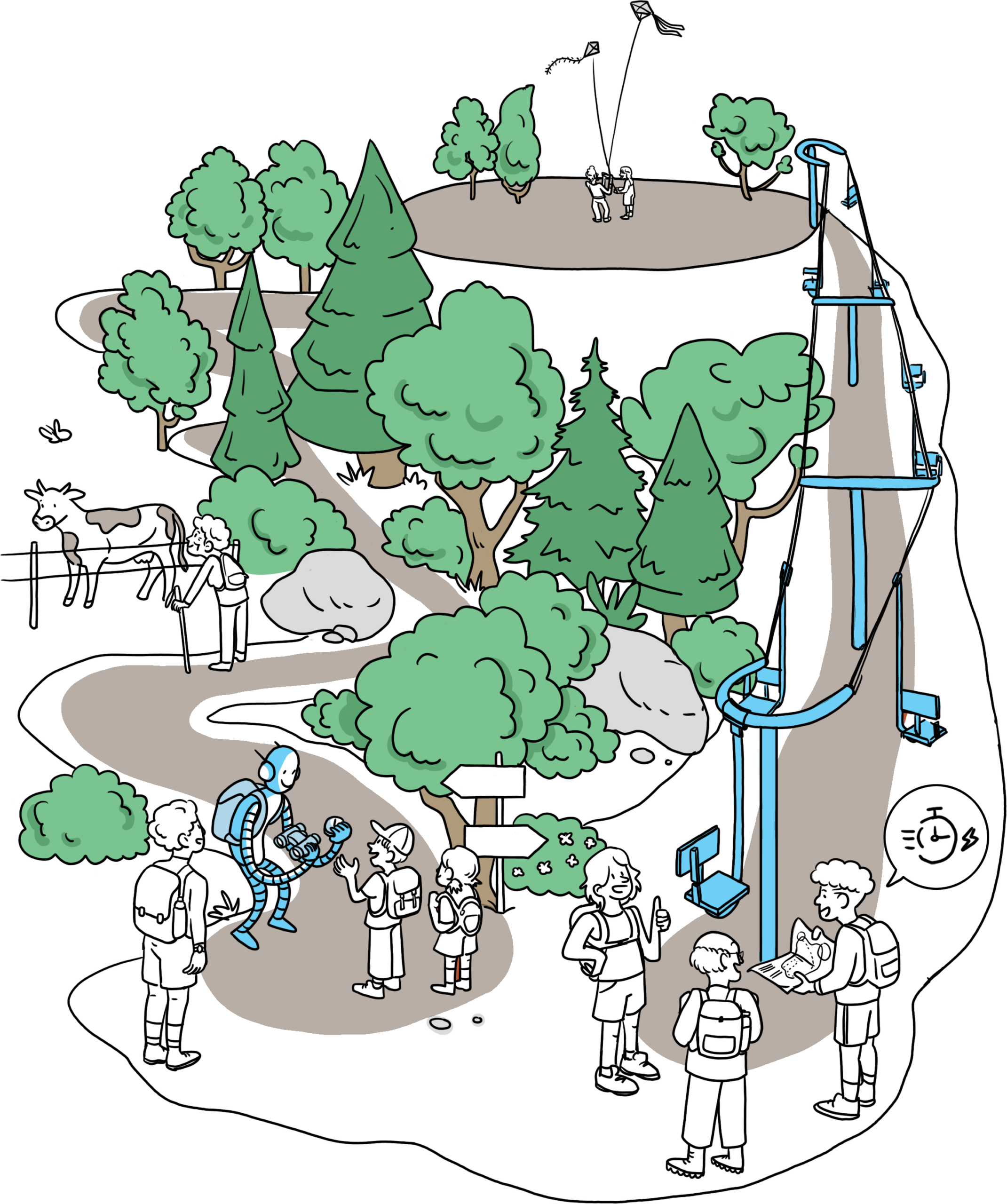
Participants acknowledge that AI and NS can help us improve our (cognitive) performance and become more efficient and productive. AI can also support us in, or release us from, the most boring and tedious tasks, possibly freeing time for more meaningful or agreeable activities. Many participants highlight the transformative potential of AI on the manner we work and on economic realities. AI also deeply transforms education with the difficult questions related to assessment processes and homework assignments, but also with stimulating opportunities for new ways of teaching and learning (personalized learning, AI tutoring, assistance to self-testing …).
Participants thus largely recognize that education should adapt to these new realities, not only within educational institutions, but also more broadly in society at large. Pedagogical approaches need accounting for new possibilities offered by technology to children and students (the negative as well as the positive ones). Education ought to prepare them for the future socio-economic context they will live in.
However, many participants suggest that merely adapting is not enough. For instance, one could wonder about what motivates judgments about what we should go on learning or not. Such judgments should of course respond to new technological possibilities, but they also reflect the manner jobs are valued and recognized, which can also be questioned. More broadly, discussions point out that education should prepare children and students to face and address the deep and complex challenges humanity encounters. In this perspective, merely adapting to the evolution of digital technology could even prove extremely dangerous. Participants notably insist upon the importance of opposing some harmful technological trajectories such as those threatening people’s autonomy (e.g. when fostering motivation of children and students through surveillance or gamification, or with AI taking too much space in people’s life when recommending information and actions). Education should thus foster the development of autonomy and critical thinking. It should also support children and young people in finding their own path and reflecting upon the meaning of life. It should not be reduced to knowledge and skills acquisition (enabling one to ensure a function in society) but should also be about how to deal with emotions and social relationships, or about values, ethics and moral decision-making.
Finding the right balance between helping children and students to adapt to the future society they will live in and supporting them in their ability to question and transform it is a key question and challenge education needs to confront with.
Insights from NHNAI academic network:
A. The importance of fostering critical thinking and autonomy
Federico Giorgi (post-doctoral researcher in philosophy, Université de Namur, ESPHIN) and Nathanaël Laurent (associate professor in philosophy of biology, Université de Namur, Belgium)
The idea that schools should not only adapt to the changes taking place in the world but, above all, educate students in critical thinking is absolutely and entirely valid. This is especially true when it comes to the major shift represented by the rise of AI, whose effects on students’ psychological and emotional well-being are still not fully understood or assessed. It is therefore essential, first and foremost, to raise students’ awareness of the risks associated with digitalization—such as the potential to develop some form of technology dependency—by providing them with the tools and support they need to protect themselves. Of course, this does not mean ignoring the fact that AI also offers opportunities to carry out stimulating projects. However, students who are aware of the limits of AI technologies and accustomed to critical thinking will undoubtedly be better equipped to distinguish between beneficial uses of such technology and harmful ones.
Juan R Vidal (associate professor in cognitive neuroscience, research center Confluences: Sciences and Humanities (EA 1598), UCLy, Lyon (France)
Education is also important to help us understand each one own complex life through time. The understanding of our interactions with our world, of our emotions, our values, our experiences also feed on learning from education. Beyond the purpose of skills acquisition for integration within the job market, education also builds in us a thought-matrix through which we navigate and which we enrich with new knowledge and new skills, but also new memories and emotions. Understanding what happens at all times is a challenge in an ever-increasing complex world and constitutes a global sense to one’s existence. If education is diminished in its quality by not only reducing critical thinking but also reducing individuals’ sense for autonomy, then uses of AI may affect our deepest sense of humanity.
As AI technology pervades educational systems beyond its control, it is important for the latter to stimulate educational practices that foster critical thinking, slow thinking, reading, complex problem solving. It is hardly possible to completely forbid access to and use of AI systems. But it is possible to reduce the time students use it, for instance through moments and activities where it is not allowed, accessible or useful. This notably means reducing digital interfaces by engaging in activities devoid of them. It could come down to reading a good paper book and analyzing its content collectively, with guidance of human teachers that stimulate critical thinking, but also curiosity, which is an important motivater for self-interest in everything and anything.
B. In what ways does the integration of AI into education challenge or redefine our humanity?
Jane Nambiri (Educationist and researcher affiliated with CUEA, Educational Research and Evaluation – Research Fellow, Directorate of Research at Catholic University of Eastern Africa (CUEA). and Paschal Wambiya (Lecturer and researcher at the Catholic University of Eastern Africa (CUEA), Educational Research and Evaluation)
To be human in the time of AI in education means affirming and nurturing the uniquely human qualities that machines cannot replicate such as empathy, moral reasoning, creativity, relationality, self-awareness, and the capacity for meaning-making. While AI can enhance learning through personalization, automation, and data analysis, it is important to note that it cannot replace the depth of human relationships, the wisdom of ethical discernment, or the holistic development of the person. In this context, being human in education means recognizing that learners are not merely data points or performance outputs rather, they are individuals with dreams, emotions, cultural identities, and spiritual dimensions.
Therefore, education must involve fostering critical thinking, dialogue, and interpersonal connection, instead of reducing learning to algorithmic outcomes. Moreover, neuroscience supports this view by emphasizing the importance of emotional safety, social interaction, and embodied learning for cognitive development. Ultimately, to be human in the age of AI is to ensure that technology serves human dignity and flourishing, rather than the other way around. Consequently, it challenges educators to balance innovation with compassion, and to use AI not to replace, but rather to amplify, the best of what it means to teach and to learn as human beings.
Human beings are complete in themselves, which expresses a profound belief in the inherent dignity, worth, and wholeness of every person. It means that each human being possesses within him or herself the potential for growth, meaning, and fulfillment, without needing to be defined or completed by external tools, technologies, or systems. This view is supported by humanistic psychology, which sees people as naturally oriented toward self-actualization, and by theological traditions that affirm the sacredness of the human person as created in the image of God. In the context of education and the rise of artificial intelligence, this idea reminds us that while AI can support learning and development, it cannot replace or complete what is already whole. Human beings bring to education qualities that machines cannot replicate: empathy, conscience, creativity, relationships, and the capacity for reflection and moral decision-making. Recognizing that people are complete in themselves does not deny the value of community or the benefits of support systems like AI, it simply affirms that human value is not dependent on technological enhancement. Instead, technology should serve the human person, not define or diminish their completeness.